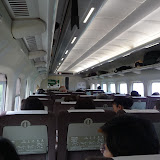
The Shinkensens, or “Bullet Trains” have to be experienced to be fully appreciated. Your ticket designates what rail car you are seated in and you wait near the marks on the rail platform that mark the entrance to your car. The trains come and go every few minutes, and depending on which train you take, it stops at different locations. Unlike the airlines, the trains run on time. They pull into the station at the designated time, and within about two minutes, people get off and new passengers get on. The train then accelerates smoothly to a running speed of about 230 kms. per hour. Most people will bring on a box lunch (Bento) to eat on the train, but a drink service is offer for a fee similar to how it is done on an airline. We purchased Rail passes before coming to Japan that for about $300 per person, so we can have unlimited use of them for a week. I filmed a short video so you can appreciate the speed at which you travel.
Kyoto is a city in central Japan that at one point in history was the capital of Japan. The city is filled with lots of shrines and temples, and as with most things in Japan, are very “famous”. We visited three major ones. The Golden Temple, which is covered in Gold leaf and was reconstructed in the 1950’s after it was burned down by an arsonist, is the best known. The Silver Temple was being renovated, but its gardens were spectacular, containing large white sand area with cultivated patterns in it. The third shrine was a large wooden one, which was located up on a hillside overlooking Kyoto. Every shrine was surrounded by vendors of souvenirs, most of them all selling exactly the same junk.
It was hot in Kyoto. We stayed in a vacation home that I found on the Internet, and luckily it had air conditioning. It was really nice place. It had one of those fancy toilets that squirt warm water at your butt. Works better than I thought. It has a safety mechanism built into it, so if you stand up while it is squirting, it shuts off. (Tom told me that – I guess he was trying to get a look at it in action) The washer/dryer was an all in one unit, so you don’t have to have two machines. The drying process is different than on our dryers. It simply seems to bake the clothes, with no air flow being forced through them. There was not an air vent that I could see on the machine. Instructions were all in Japanese of course, and Chris cursed more than once at the machine.
Dinner the first night was at Japanese fast food joint. Food is all traditional Japanese, but you order and pay for your food at a vending machine. It prints out a ticket that your server takes. It was decent enough food, and the process saved staff from entering orders or collecting money. You could each as much rice as you wanted. We saw one guy go back for three additional helpings.
On Tuesday we took the Shinkensen again and headed to Hiroshima. We visited the Peace Memorial Park. They have a museum about the bombing that we also went through. Even when you see pictures of the damage caused by the nuclear blast, it is hard to imagine that something that powerful exists. I sure hope one of those bombs doesn’t fall into the hands of a terrorist or political leader that thinks somehow by detonating it will solve some problem. Katie was impressed by the story of the little girl who believed if she made a 1000 paper cranes, she would get better. Of course, she didn’t, but kids from around the world still make strings of paper cranes and drape them across a memorial to her. Katie also spent the evening making cranes of her own.
On Wednesday, we went out to Miyajima Island. This is where the large red Tori Gate in the water is located that you see on all the posters of Japan. It is suppose to be special, because at high tide, you can paddle a boat under the Tori Gate and right into the Shrine without touching the ground. The rest of the Island is a quiet, but non-the-less a tourist trap.
We had lunch at a restaurant that served Okonomi-yaki. It is a thin pancake, with cooked shredded cabbage, soba noodles, egg covered in a sauce. Hiroshima is known for this dish, and we sat at the counter in front of the cooking area and watched them make them.
That night we went out for Shabu-Shabu. It is one of my favourite Japanese dishes. A portable propane cooktop heats a cast iron pot of boiling water. Using long chopsticks, you swirl paper thin slices of beef through the boiling water until cooked and then dip them in a sesame seed sauce before eating. You also do a similar process with cabbage, mushrooms, leeks, and tofu. It can be messy, but it is very good.
Today is our last day in Japan. We are heading into see the Sumo Wrestling Tournament in Tokyo this afternoon. We catch the bus for the airport in the morning. Our time in Japan has been great, but as with every place we have visited so far, when it is time to move on we are ready to do so. I mentioned to Chris, that in these three weeks, we have seen all the best things I spent a year seeing 20 years ago. Friends, Kite Festival, Kyoto, Hiroshima, Shinkensen, electronics, Sumo, Cherry Blossoms, and Shrines are all the best memories of my stay 20 years ago, which I have experienced again. We have also had our fill of Japanese food, some that we love and some not so much.
California here we come... Ian
A View from the Shinkensen
 |
| Japan - Day 19 - Kyoto and Hiroshima Trip |


1 comment:
[url=http://www.kfarbair.com][img]http://www.kfarbair.com/_images/logo.png[/img][/url]
בית מלון [url=http://www.kfarbair.com]כפר בעיר[/url] - שירות חדרים אנו מציעים שירותי אירוח מגוונים כמו כן יש במקום שירות חדרים המכיל [url=http://www.kfarbair.com/eng/index.html]אחרוחות רומנטיות[/url] במחירים מפתיעים אשר מוגשות ישירות לחדרכם...
לפרטים נא גשו לאתרנו - [url=http://kfarbair.com]כפר בעיר[/url] [url=http://www.kfarbair.com/contact.html][img]http://www.kfarbair.com/_images/apixel.gif[/img][/url]
Post a Comment